Get Ski Fit Before Your Holiday: Your 8-Week Countdown
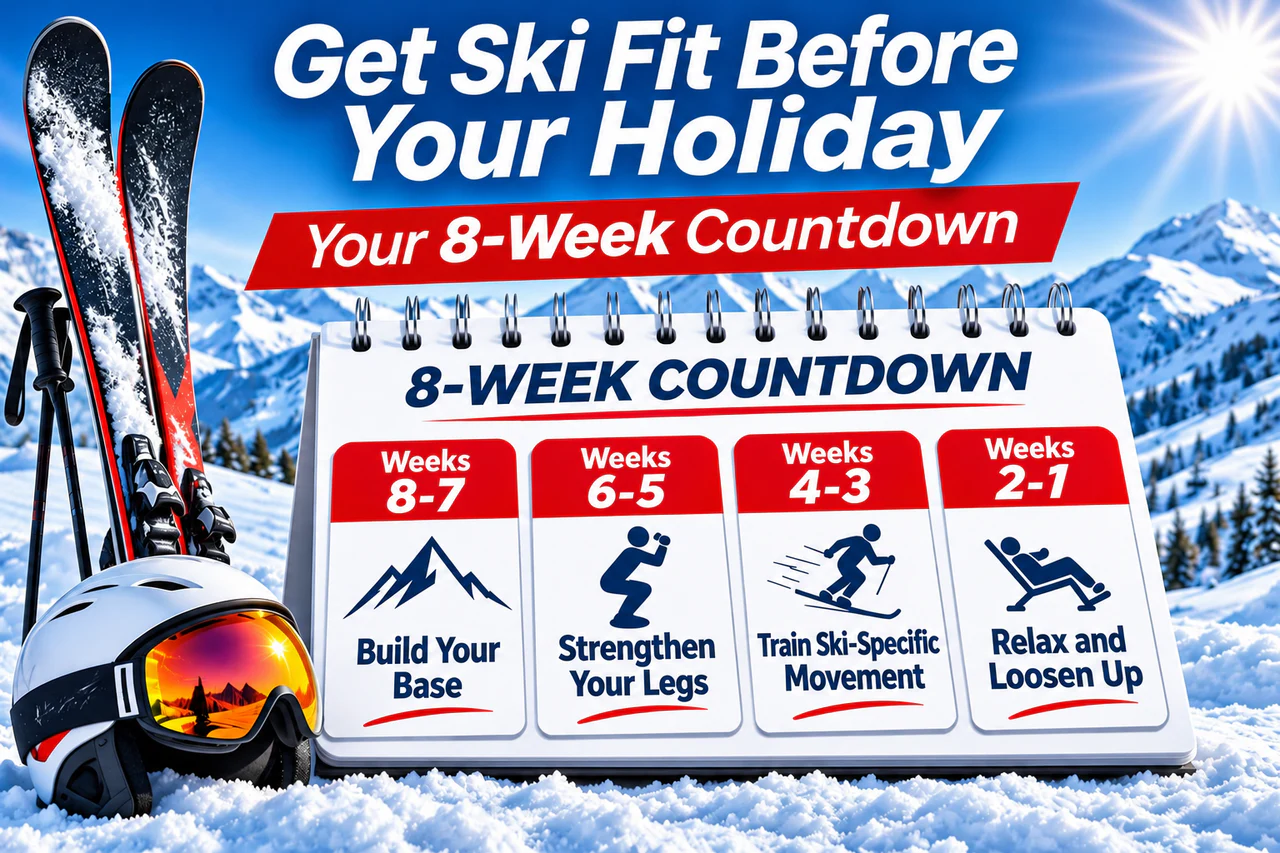
Get Ski Fit Before Your Holiday
You’ve gone ahead and booked your skiing holiday – great! You’re probably already excitedly imagining yourself gliding down the piste, but before you hit the powder, we need to talk about your pre-ski exercise plan. Skiing is a sport that uses your whole body, and a little bit of training before your trip can help make your holiday more enjoyable.
The good news is that you don’t need a premium gym membership or a military-grade exercise programme. A few simple bodyweight exercises done a few times a week can make a huge difference on the slopes.
Here’s your simple, fuss-free exercise routine to help you get ready for skiing.
Your Skiing Exercise Plan
Our pre-ski holiday exercise plan is deliberately simple – you won’t need to buy a gym membership, weights, or fancy equipment. This whole plan uses bodyweight-based exercises to improve your key muscles for skiing; legs and core. We also recommend improving your overall cardio (heart strength) and baseline stamina – this will help you enjoy your skiing days for longer without feeling out of breath.
Every 2 weeks, the exercises in this plan increase in difficulty to help you prepare for the specific movements you’ll use when skiing. You can add, take away, or adjust exercises in this plan to suit you. The most important thing is that you’re doing exercises you enjoy and feel that you can stick to.
We recommend doing your pre-skiing exercise routine 3-4 times per week, with a rest day between to give your body time to recover. Always start each exercise session with a gentle warm up and finish off with a light cool-down.
Weeks 8-7: Build Your Base
Start your exercise routine about eight weeks before your trip – if you can start earlier, even better. Initially, we’re just focusing on building your baseline cardio and beginning to get your key skiing muscles (legs and core) used to moving again. At the start of your routine, keep it simple and listen to your body.
Do 3 times a week:
- Bodyweight squats – 2 sets of 12. Place your feet shoulder width apart and lower your bottom like you’re sitting on an invisible chair with your knees over your toes.
- Glute bridges – 2 sets of 12. Lie on your back with your feet flat, lift your hips then slowly lower your bottom towards the floor.
- Plank – 3 x 20 seconds. Rest on your forearms and the tips of your toes, keeping your body flat. Imagine pulling your bellybutton towards the ceiling.
- Cardio – 20-30 minutes. Choose any activity you enjoy doing that raises your heart rate. Swimming, cycling, or a brisk walk around your neighbourhood are all great choices.
Weeks 6-5: Strengthen Your Legs
Your leg muscles and core are most important for skiing; your legs provide power while your core helps with balance and stability. Your next two weeks are all about strengthening these key muscle groups to give you power, stability and control on the slopes.
Do 3 times a week:
- Reverse lunges – 2 sets of 10 each leg. Place your feet
- Wall sit – 3 x 30 seconds. With your back against a wall, lower like you’re sitting in an invisible chair. Your knees should sit at a 90° angle. This exercise is great for practicing the semi-seated position you’ll be in when skiing.
- Calf raises – 2 sets of 15. While standing straight, slowly lift your heels until you’re standing on your tiptoes, then gradually lower.
- Side plank – 2 x 20 seconds each side. Lie on your side with your forearm flat on the floor at shoulder height, stack your legs on top of each other and hold your body in a straight line, then swap sides.
- Cardio intervals – 30 seconds hard, 90 seconds easy, repeated 6-8 times. Skiing is stop-start, so this exercise replicates what your trip will really be like. Training your body to get used to small bursts of speed helps your heartrate to return to normal quickly.
Weeks 4-3: Train Ski-Specific Movement
Now your muscles are stronger, it’s time to train your balance and the ski-specific movements you’ll use on the slopes. These next two seeks are all about balance and power transfer from one leg to the other.
Do 3 times a week:
- Squats – 3 sets of 12. Squats are back, but with more reps. This time, aim to go as low as you can manage and hold for 3 seconds at the bottom before rising.
- Skater hops – 3 sets of 10. Bound from side to side landing softly on one leg.
- Single-leg balance – 3 x 30 seconds each leg. You can make this harder by standing on a soft surface such as a cushion.
- Step-ups – 2 sets of 10 each leg. Use a sturdy low chair, bench, or even the bottom of your staircase.
- Plank with shoulder taps – 3 x 10 each side. Planks are also back, but with a twist. Move into a high plank position (arms extended) then lift one hand to tap the opposite shoulder.
- Continue your cardio intervals
Weeks 2-1: Relax and Loosen Up
On the last 2 weeks before your trip, ease off on the exercises. Overdoing it risks causing yourself an injury and ruining your entire trip. Instead, you can take things easy (and concentrate on packing!)
Do 2-3 times:
- Your favourite exercises from the last few weeks – keep it light and short.
- Stretching – focus on quads, hamstrings, hips and calves.
- Easy cardio – keep your body moving, but don’t tire yourself out.
Tips to Stay Fit During Your Ski Trip
Before you speed off down the slopes, here’s a few tips to keep in mind to get the most out of your trip.
- Warm up before you start and have a little stretch between runs or while waiting for the ski lift. Don’t forget to cool down.
- Take it steady on the first few days and don’t overdo it. Sore muscles on day one will make your whole trip miserable.
- Stop when you’re feeling tired, take breaks and listen to your body.
- Drink plenty of water out on the slopes. The altitude, cold air, and exercise will make you dehydrate much faster than usual.
Other Top Tips for a Great Ski Holiday
Once you’ve put in all that work to get fit for skiing, you don’t want your holiday ruined because you’ve forgotten the essentials! Here are our tip tips to make sure you have a great ski holiday.
Boots: Buy Don’t Borrow
Fitness might prepare your body, but your boots are the major deciding factor in how well you can control your skis. Hire boots at the resort have been worn by hundreds of pairs of feet, making them lose and uncomfortable, and nothing spoils a ski trip faster than aching feet. In the worst-case scenario, badly fitted ski boots can cause injuries to your feet, shins and joints.
Custom fitted ski boots feel completely different. They’re moulded to your exact foot shape by one of our trained boot fitters, ensuring your feet stay comfortable and warm during your whole trip.
We recommend booking your ski boot fitting early, as appointments fill up fast close to ski season.
Helmets: The New Law
In November 2025, Italy introduced a new law that made helmet use mandatory for all winter sport participants regardless of age and experience. If you’re skiing in the Italian resorts, you’ll need to wear a CE-certified helmet, and if you’re caught without one, you’ll face a hefty fine.
If you’re skiing in other locations around the world, a helmet is still advisable, as wearing a ski helmet reduces the risk of severe head injury such as skull fractures. In most resorts, wearing a ski helmet is now more popular than not wearing one – the days of speeding down the slopes unprotected to look “cool” are long gone.
While you can usually buy helmets at the resort, they’re often much more expensive. It’s better to buy your helmet now to save you from paying resort prices. We also recommend buying your helmet and goggles together so you can check the fit – if you already own goggles, then bring them with you when you fit your helmet.
Packing: Things People Forget
There are a few essentials that skiing pros always remember to pack that holidaymakers often don’t know about. Here’s a few things to remember so you don’t get caught out:
- SPF – Sunblock in the snow might sound crazy, but the sunlight at high altitude is more intense and the white snow bounces light back at your face.
- Sunglasses – For the same reasons why you need SPF, sunglasses are a must when skiing. We stock a range of sporty skiing sunglasses in both rimmed and rimless designs from iconic brands like Revo and Sweet Protection.
- Moisturiser – The combination of cold mountain air and central heating in chalets and restaurants will quickly leave your skin feeling dry, especially on exposed areas like your face. Pack a thick moisturiser and use it before skiing to shield your skin as well as after to replenish moisture.
- Ski socks – Thick socks might be your first thought for skiing, but they actually make your feet colder as they restrict blood flow. Instead, you want a few pairs of good quality technical ski socks – we love Falke brand, but we also stock Therm-ic heated socks for those of you who suffer with seriously cold feet.
Our guide on what to pack when skiing includes a free PDF packing list download with everything you need to remember for your holiday. You can buy almost all of your skiing essentials with us, online or in store.
The Final Verdict
Just eight weeks of small exercises ahead of your ski holiday can make a really big difference to how you feel when you’re out on the slopes. A bit of extra effort now can help make your holiday all that much more enjoyable – you don’t need an expensive gym subscription or fancy equipment, just simple exercises that you can do while the kettle boils are enough to help you feel fitter and stronger for skiing.
It’s not just your fitness that helps make your skiing holiday more pleasant – don’t forget to pack your essentials. Comfortable ski boots, a helmet, sunglasses and a few good pairs of ski socks are absolute must-haves. Enjoy your holiday!
Boot fitting Helmets Sunglasses Socks
Frequently Asked Questions
How long before my ski trip should I start exercising?
The earlier you start training for your ski holiday, the better. Twelve to eight weeks is ideal, but even just four weeks of regular exercise ahead of your trip will help. If your trip is even closer than that, start today and focus on squats, lunges and balance work to build up your leg strength – even if you do a few squats watching telly, something is always better than nothing.
How much should I exercise before skiing?
20-30 minutes of exercise three times a week is more than enough for holiday skiing. Leave at least one day of rest between sessions so your muscles can recover and get stronger. It might not seem like much, but a little bit of exercise will make a big difference when you get on the slopes.
Which muscles should I focus on for skiing?
Your quads, glutes, hamstrings and calves do most of the work when skiing, while your core keeps you balanced and stable. Leg strength, balance and mobility help you stay in control of your skis, while improving your stamina and cardio will help you enjoy your trip more.
Do I need to go to the gym to train for skiing?
No, you don’t need a fancy gym subscription to train for your ski holiday. If you prefer to train at the gym, then you can, but there’s plenty you can do to get ski-fit at home without an expensive gym membership or equipment. Squats, lunges, planks and balance work are all simple bodyweight exercises you can do at home throughout your day – no need to buy weights or carve an hour from your evening to head to the gym.
What if I’m a complete beginner?
Start gently and build up slowly. Most beginners find that leg strength and a bit of stamina make learning far easier and less tiring. Taking a lesson on your first day will also help you progress faster and ski more safely.
Should I stretch before and after skiing?
Absolutely. A few stretches before you hit the slopes and in between runs helps keep your body loose throughout the day. A cool down and a good stretch before you head off for drinks après ski also helps to reduce stiffness and soreness the next day.
Are properly fitted ski boots really worth it?
Yes, a pair of properly fitted ski boots are absolutely worth investing in, even if you only ski once a season. Boots act as a link between your leg and your ski, allowing for better control. A professional fitting finds the right shape and size for your foot, ensuring a comfortable fit. Nothing ruins a ski trip faster than sore feet!
Do I need to wear SPF when skiing?
Yes. Even on cloudy days, UV rays pass through cloud, and at altitude the sun exposure is higher. Snow also reflects sunlight back up at you, so wear SPF 30 or higher on any exposed skin. Don’t forget to reapply your sunblock throughout the day too.
What should I do if I get muscle soreness when skiing?
Gentle stretching, a warm shower (or a soak in the hot tub if your chalet has one) and plenty of water will help. A short walk the next morning to loosen up will also help. If you’re really struggling, take a day to rest rather than risking injury. There’s always plenty to do and explore around resort towns other than just skiing.
Can I still ski if I haven’t done any training?
Of course, everyone has to start somewhere! While it’s recommended that you have a good level of baseline physical fitness, you can enjoy a skiing trip without needing to live at the gym. You may simply need to take more frequent breaks to get your breath back and to avoid muscle pain.